What gauge means in body piercing jewelry
Gauge measures wire thickness in body jewelry. The scale runs in reverse, meaning higher numbers mark thinner metal posts and rings. We mill our 316L surgical steel collection around four specific sizes between 0.8mm and 1.6mm. Checking this measurement against your original piercing dimensions prevents ordering a post that sits loose or fails to fit through the channel.
Understanding the reversed gauge scale
The American Wire Gauge standard sets jewelry thickness. Wire mills created this system by pulling heated metal rods through progressive draw plates. Each pass through a smaller die thinned the stock and added one draw count to the tally. A rod pulled twenty times became thin 20G wire, while a rod pulled fourteen times remained thick 14G stock. That historical industrial process created the backwards numbering system used on modern jewelry posts.
Our shop builds pieces using these established wire diameters. A 14G post measures 1.6mm across its solid center, while a 20G wire measures 0.8mm. The steps between numbers seem tiny on paper, but a fractional millimetre changes how rigid a curved barbell sits or how a hinge operates. Remembering that larger gauge numbers equal thinner wire helps you navigate the entire catalogue without confusing length, diameter, and post thickness.
The four main catalog gauges
We focus our 316L surgical steel production on four standard sizes. Our 14G pieces measure 1.6mm across. We turn this thickness into curved navel barbells, straight tongue barbells, and industrial rods that need rigid structural strength. The metal core supports threaded ball ends and stone bezels without bending during wear. You will find this 1.6mm wire across our entire belly ring and barbell inventory.
Smaller placements use our 16G, 18G, and 20G stock. Our 16G wire measures 1.2mm, which serves as the core for flat back labret studs, cartilage posts, and heavier clickers. Next is 18G at 1.0mm, used for nose rings and intermediate ear hoops. Our thinnest option is 20G at 0.8mm, matching traditional lobe posts. Each size preserves mechanical strength while keeping the cubic zirconia settings balanced on the post.
Metric conversions for metal posts
Millimetres give you an exact physical measurement. A caliper reading shows that 20G is 0.8mm, 18G is 1.0mm, 16G is 1.2mm, and 14G is 1.6mm. Moving from 20G to 14G doubles the total thickness of the steel post. That jump of 0.8mm alters how a straight bar sits inside a channel. Metric units remove the confusion of gauge numbers because calipers measure the absolute distance across the outer wire wall.
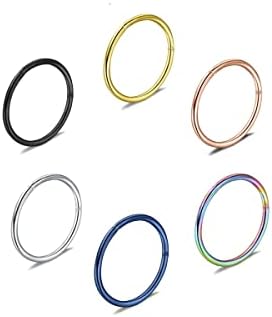
We stamp and list both measurements for clarity. Our hypoallergenic 316L surgical steel maintains uniform diameter along the entire shaft, whether finished in raw steel, gold, rose gold, or black. Plugs and tunnels in obsidian, jade, acrylic, and silicone shift off the wire gauge scale entirely, measuring directly in millimetres from 6mm up to 25mm. Knowing both systems lets you verify the exact profile of any piece before ordering.
Reading gauge on our listings
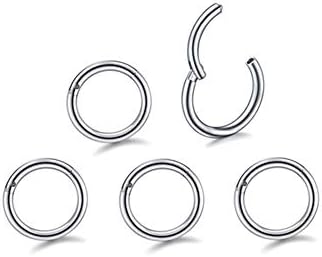
Every product title and spec block states the gauge first. A listing for a flat back labret notes 16G 1.2mm alongside the post length. Clicker segment rings state the wire gauge followed by the inside hoop diameter, such as 16G with an 8mm inner opening. Look at the post thickness separate from decorative cluster sizes or stone widths. A large cubic zirconia cluster can still sit on a delicate 18G post.
Do not confuse post gauge with barbell length or ring diameter. Length measures the wearable distance between balls on a straight post, while diameter measures inside clearance across a hoop. The gauge strictly defines the round wire stock itself. Checking the specifications table on our listings ensures you read the thickness value correctly. That prevents mistaking an 8mm hoop diameter for an 8G wire thickness, which is far thicker metal.
Matching what your piercer installed
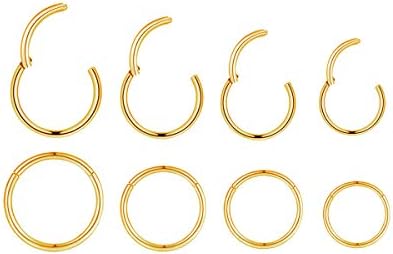
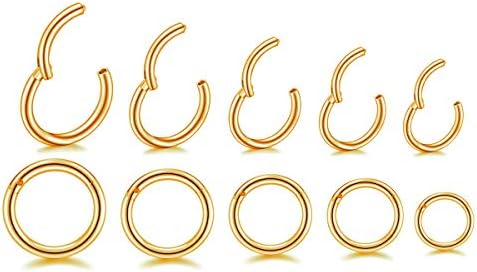
Product photographs make jewelry scale hard to judge by eye. A close camera crop makes a thin 20G nose hoop appear identical to a heavy 14G navel bar. Ordering based on photo appearance leads to mismatched hardware. A post that is too thick will not pass through the channel, while a wire that is too thin can shift around loosely. The correct gauge is always the exact size your piercer selected.
Your piercer chose a specific needle diameter suited to your anatomy and placement. If you do not remember the original gauge of your channel, visit your piercer to ask for the measurement. They can examine the placement and confirm whether you need a 1.2mm 16G post or a 1.6mm 14G bar. Once you have that metric figure, you can select the matching 316L surgical steel piece from our collection.
The short version
- Gauge numbers run in reverse, meaning higher numbers describe thinner metal wire posts and clickers.
- Our four primary jewelry gauges are 20G at 0.8mm, 18G at 1.0mm, 16G at 1.2mm, and 14G at 1.6mm.
- Gauge measures the thickness of the metal post, separate from post length or hoop inside diameter.
- Ask your piercer for your exact size rather than guessing post thickness from product listing photos.