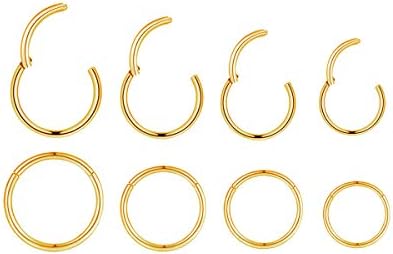
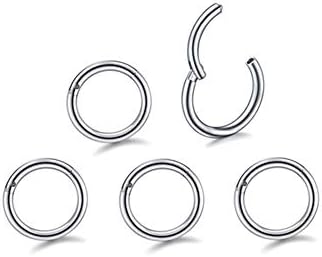
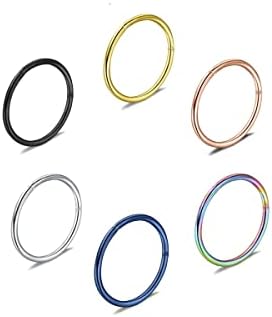
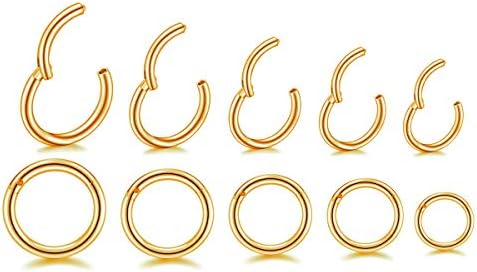
How a hinged segment hoop closes
A hinged segment ring opens on a tiny steel pin and shuts with a mechanical snap. We machine our clickers from 316L surgical steel in 16G, 18G, and 20G. The curved post swings open on its pivot, clears the channel, and returns to a latch socket on the other side. That tactile click tells you the wire is seated.
The anatomy of the hinge
A clicker relies on two junction points cut into one solid circumference. On one side sits a micro hinge, built around a ground steel pin that lets the arc swing freely. On the opposite side, the free end tapers into a tongue or notched post. This post meets a hollow groove cut into the stationary body of the hoop.
The metal has to align with strict tolerances. We machine the moving segment from the same wire stock as the ring body so the profile stays uniform around the entire diameter. When you press the segment downward into the socket, the steel flexes a fraction of a millimetre before snapping into the notch. That tension holds the loop shut without extra parts.
Clickers compared to older hoop styles
Older hoop designs rely on different mechanical principles to stay closed. A captive bead ring traps a loose dimpled metal ball between two raw wire ends using spring tension. If you pull the ring open too far, the ball drops and can roll away. Replacing that bead requires steady fingers or dedicated ring opening pliers to spread the gap.
Plain continuous rings demand that you twist the wire ends past each other sideways to insert the hoop. Twisting steel back and forth work-hardens the alloy over time, which causes metal fatigue and distorts the circular profile. A hinged segment ring keeps its exact round shape because the arc moves on an axle instead of bending the metal shaft.
Polishing the seam and joint
A raw hinge joint leaves minute tooling ridges along the outer diameter. After assembling the pin, we run our 316L surgical steel clickers through multi-stage tumbling and hand buffing on wheels. This step knocks down the perimeter edges where the moving arm meets the stationary rim. The surface finish must remain level so the seam feels smooth across your fingertip.
The polish extends to the inner curve where the hoop rests against the channel. We clean the latch pocket to clear out compound residue that might jam the mechanism. A clear latch ensures the notched post seats deep into the receiver. The junction should look like a continuous line of steel once closed, with no burrs catching along the outer edge.
Handling the segment without lateral strain
Hinges are built to swing along a single flat plane. When handling the ring, place your thumb and forefinger on the stationary rim, then lift the moving bar straight outward with your other hand. Never twist the moving segment sideways or peel it away at an angle. Lateral force torques the pivot pin inside its housing and widens the joint.
If the hinge gets bent out of alignment, the tongue will miss the receiver pocket entirely. You would have to force the arm back into line, which weakens the pin. Keep all opening and closing motions parallel to the hoop diameter. If you have trouble handling a hoop in a hard-to-reach area, visit your piercer so they can seat the piece using proper ring pliers.
What to check if closing feels stiff
A clicker that resists closing usually has dried residue or lint sitting inside the receiver notch. Even a microscopic speck of debris prevents the tongue from dropping deep enough to catch the detent. Inspect the female socket under a strong light. Wipe the latch area dry with a clean lint-free cloth and check that the moving post is clear of obstruction.
New steel clickers also have tight factory tolerances. If the arm feels unusually stiff on its hinge, the joint may need to pivot a few times outside the piercing to settle the pin. Never use heavy pliers to crush the seam closed. If the post refuses to click into position after clearing the notch, ask a professional piercer to inspect the closure.
The short version
- A hinged clicker uses a ground pivot pin and a notched post that snaps into a machined receiver.
- Unlike captive bead rings or twist hoops, a clicker maintains its round shape without dropped beads or metal fatigue.
- Always swing the moving arm along its natural path to avoid bending the hinge pin sideways.
- Clear lint and residue from the receiver socket if the moving segment resists snapping into its locked seat.