How flat back labret posts fit and thread
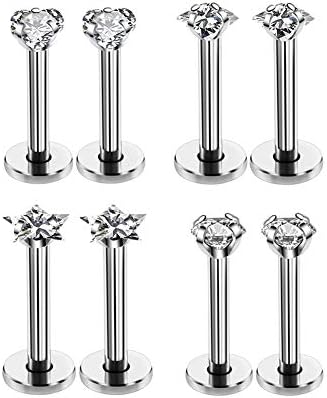
A labret post combines a fixed base disc and a straight shaft. The front accepts a separate decorative top, like a bezel gem or steel bead. Because the back plate lies flush against the tissue, it replaces the round ball found on standard barbells. We machine our flat back labrets from 316L surgical steel at 16G, which measures 1.2mm in wire thickness.
The anatomy of a flat back stud
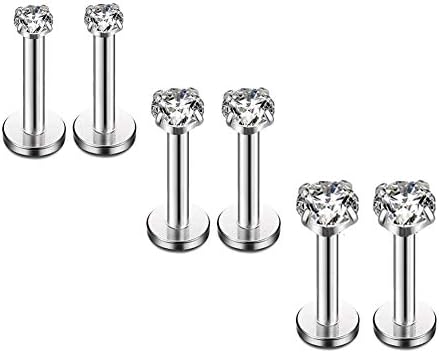
A standard barbell has two removable balls. A labret post differs by welding or machining a smooth, flat disc directly onto one end of the shaft. The opposite end holds the decorative cluster, cubic zirconia stone, or plain steel ball. This design distributes contact across the surface of the disc. The base stays put while only the front attachment unscrews during a change.
The low profile of the base disc keeps the back of the jewelry compact. In lip placements, the flat surface rests against teeth or gums rather than presenting a spherical obstruction. In ear placements, the flat disc rests behind the lobe or cartilage plate. We polish the 316L surgical steel disc to a mirror sheen so the edges stay rounded and smooth.
Placements beyond the lip
The name labret points to the lower lip, but the post geometry serves many ear locations. Tragus, helix, conch, flat, and standard lobe placements frequently use the exact same post. A round barbell ball behind the ear can catch on hair, shirts, or telephone handsets. The flat disc reduces snag points against clothing and lays flat during sleep.
In a tragus placement, space inside the ear canal is narrow. A spherical backing occupies room that earbuds need. A flat disc post leaves the canal entrance open while holding the front gem secure. Forward helix and high cartilage spots also benefit from the thin base. The disc sits against cartilage without tipping, provided the post length matches the channel thickness.
Internal threading versus external threading
Thread design dictates how the decorative top connects to the post. External threading places the screw ridges directly on the outside of the wearable 1.2mm bar. When inserted through skin, those bare ridges scrape the channel walls. We use internal threading for our 16G flat back posts. The hollow shaft contains female threads, while the decorative front piece carries the male screw post.
Internally threaded jewelry leaves the outer surface of the 16G post smooth from end to end. The solid base and the shaft slide through the tract without exposed ridges catching on the passage. Tops must match the post threading precisely. A 16G internally threaded top made for a 0.9mm thread pitch will not thread into an externally threaded shaft or a mismatched diameter.
Comparing 6mm and 8mm post lengths
Post length measures the wearable distance between the flat base and the bottom of the front top. It excludes the thickness of the base disc and the decorative head. We produce our 16G labret posts in 6mm and 8mm lengths. Six millimetres equals roughly one quarter inch, while eight millimetres equals five sixteenths of an inch. Those two millimetres change how the piece sits.
A 6mm post suits thinner tissue, such as a tragus, a thin lobe, or a shallow cartilage rim. An 8mm post provides room for thicker ear cartilage, conch areas, or lower lip tissue. If the post is too long, the front top tilts forward and catches on hair. If it is too short, the base disc presses into tissue. A piercer can measure your specific channel depth.
Caring for 316L steel posts and tops
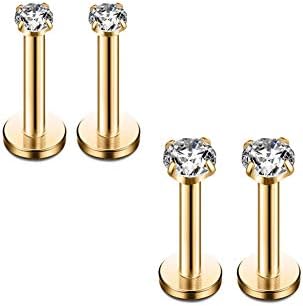
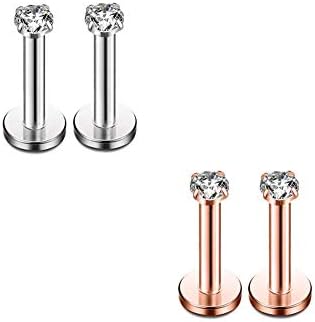
Our 316L surgical steel holds a durable finish across raw steel, gold, rose gold, and black coatings. This metal is hypoallergenic and resists corrosion from daily wear. To clean the jewelry before assembly, wipe the post and front gem with a lint-free cloth. Thread the gem on straight: cross-threading the tiny male screw into the 16G shaft will strip the steel threads permanently.
Check the tightness of internally threaded tops periodically. Small gem settings can loosen as they brush against fabric or pillowcases throughout the week. Hold the base disc flat between your thumb and index finger, then turn the front top clockwise until it seats firmly against the shaft. If you struggle to hold the small parts, visit your local piercer for a quick adjustment.
The short version
- A flat back labret uses a fixed rear disc to distribute contact evenly against skin.
- We make our labret posts in 16G, which corresponds to a 1.2mm metal thickness.
- Internal threading keeps the outer post smooth so exposed screw threads do not pass through tissue.
- Choosing between 6mm and 8mm lengths depends on the physical thickness of your cartilage or lip.